
Legends Estates Winery · Beamsville, Ontario
One estate. Three brands. One connected digital experience.
CDFX redesigned LegendsEstates.com to clarify the estate and its wine brands, improve destination planning, modernize WooCommerce and build a stronger foundation for search, answer and AI-driven discovery.
- Strategy + UX/UI
- WordPress + Elementor Pro
- WooCommerce
- SEO + AEO + AI visibility

Project snapshot
Repositioning a Niagara winery as a destination, a brand family and a modern wine store.
The estate became the organizing idea, while MAKR, Meldville and Legends wines retained distinct voices and clearer paths into story, visits and purchase.
The challenge
One website had to do four jobs without feeling fragmented.
Legends Estates is simultaneously a physical destination, a parent brand, an online retailer and the home of wine collections with different personalities.
Brand hierarchy
Explain how Legends Estates, MAKR, Meldville and the estate wine portfolio relate to one another.
Destination experience
Give visitors clear reasons to visit, practical planning details and a sense of the atmosphere before arriving.
Commerce
Move beyond a generic product archive and support brand-led discovery throughout the shopping journey.
Visibility
Align metadata, local entity facts, structured page intent and content that automated systems can interpret accurately.
Strategic tension
The redesign could not solve clarity by making every brand look or sound the same. It needed unity at the estate level and meaningful contrast at the brand level.Brand strategy
The estate became the organizing idea.
Rather than treating the website as a catalogue of unrelated pages, CDFX established Legends Estates as the master narrative and used MAKR, Meldville and Legends wines as clear expressions within it.
This structure informed navigation, page introductions, calls to action, product discovery, footer language and the order in which visitors encounter the brands.
Core positioning
Crafted at the estate. Curated by brand. One place, multiple expressions and a clear path from story to visit to purchase.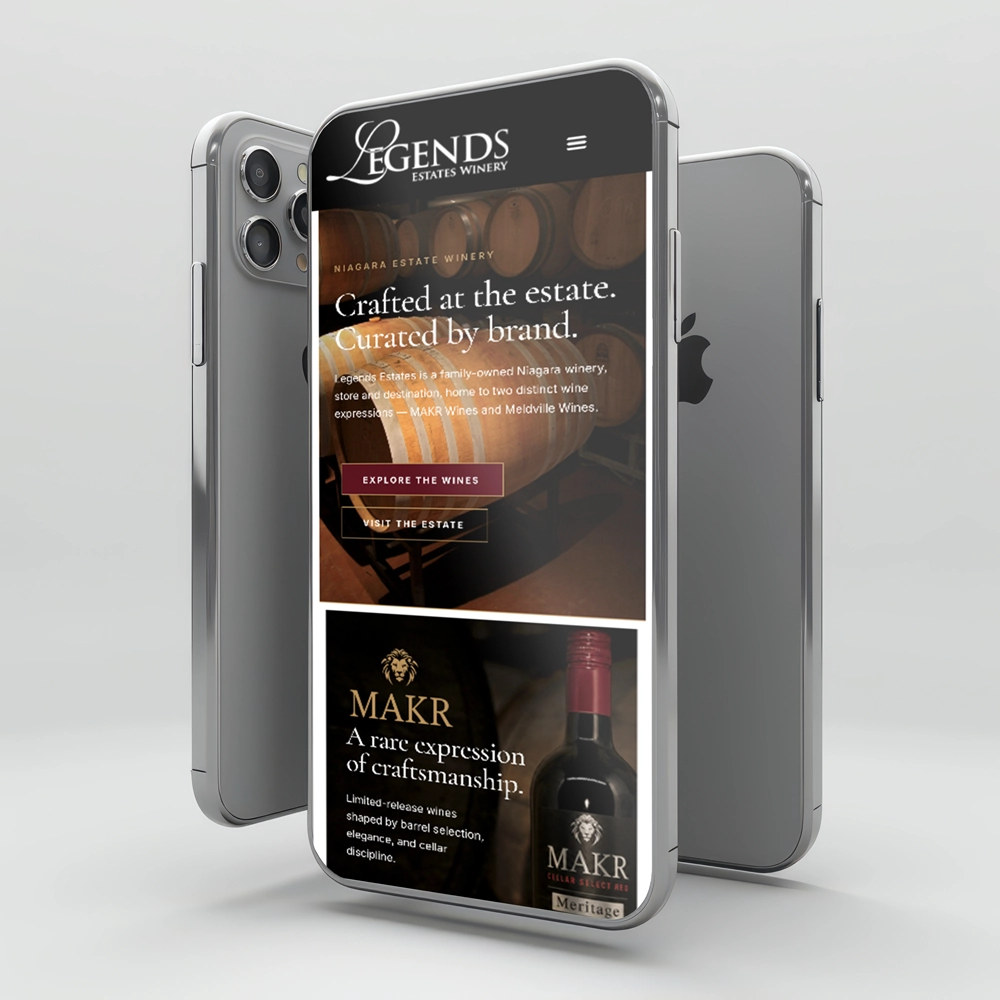
Experience architecture
Every major page received a purpose and a next step.
The new architecture separates discovery, estate planning and commerce while reconnecting them through deliberate cross-links and calls to action.
Home
Establishes the estate, introduces the brands and routes visitors toward wine, visits, events and the story.
Our Story
Builds confidence through place, family ownership, atmosphere, craft and the individual brand voices.
Visit + Events
Turns interest into action with practical details, expectations, hospitality language and related experiences.
Brand + Shop pages
Combines editorial positioning with live products so customers understand a collection before purchasing.
Design and content system
Cinematic enough to feel premium. Structured enough to remain editable.
Warm estate photography, dark editorial bands, restrained typography, brass accents and generous pacing created a premium but welcoming visual language.
Global design tokens
Cream, paper, charcoal, wine, brass and muted green formed a consistent editorial and commercial system.
Native Elementor structure
Reusable containers, headings, text, buttons, menus and dynamic widgets preserve day-to-day editing.
Responsive behaviour
Typography, spacing, navigation, imagery and product grids were adjusted for desktop, tablet and mobile.
Content hierarchy
Each page follows a clear sequence: context, story, proof or detail, related pathways and a focused final action.
Design principle
Premium, but never cold. Refined, but not remote. Considered, welcoming and comfortably unhurried.
Commerce and development
A wine shop shaped around discovery, not just inventory.
CDFX extended WooCommerce with brand-aware product presentation and custom interactions while keeping product data inside familiar WordPress and WooCommerce workflows.
Custom product cards
Branded imagery, descriptions, prices, quantity controls and clear purchase actions.
AJAX category filtering
Customers can change wine categories without a full page reload.
Featured release logic
Dynamic WooCommerce data supports highlighted wines and collection-led merchandising.
Product storytelling
Vintage, varietal, profile, aroma, palate, finish, occasion and pairings support richer product pages.
Technical approach
Native first. Custom where it creates meaningful business value.SEO, AEO, local and AI visibility
The redesign included a machine-readable foundation, not just a visual refresh.
Public content, metadata, local business facts, brand entities and page intent were aligned so the site presents a consistent answer to people and automated systems.
Page-level metadata
SEO title, meta description, canonical URL, robots, social fields, focus topic, page intent, schema template, FAQs and target query.
Local entity configuration
Business type, address, phone, hours, region, service areas, languages, logo and public profiles.
Content semantics
Clear headings, descriptive links, image alt text, brand descriptions, location language and explicit relationships.
AI retrieval foundation
Verified entity facts and an llms.txt direction were prepared without inventing platform-specific ranking claims.
Outcomes and verified technical snapshot
A clearer brand system, a stronger buying journey and a credible visibility baseline.
The immediate result is structural: visitors can understand the estate, distinguish the brands, plan a visit, explore events and move into shopping without losing context.
Desktop97Accessibility
Desktop100Best Practices
Desktop100SEO
Mobile97Accessibility
Mobile100Best Practices
Mobile100SEO
Post-launch Lighthouse snapshot supplied July 21, 2026. Agentic readiness was recorded at 2/3 on mobile and desktop. The displayed Accessibility, Best Practices and SEO figures are a point-in-time technical snapshot, not a before-and-after business-results claim.
What changed
A coherent brand architecture, dedicated MAKR and Meldville narratives, a destination-led Visit experience, events pathways and a tailored shop.
What remains measurable
Longer-term organic growth, ranking movement, revenue and conversion lift require an agreed analytics window and stored data.
Strength confirmed
SEO and Best Practices scored 100, with Accessibility at 97 on both device profiles in the supplied snapshot.
Evidence boundary
This case study documents completed work and the verified post-launch technical snapshot. It does not invent traffic, ranking, conversion or revenue results.Direct answers
Questions about the Legends Estates redesign.
The answers below summarize the completed scope and the evidence boundary used throughout this case study.
What did CDFX build for Legends Estates Winery?
CDFX delivered strategy, UX/UI, content direction, WordPress and Elementor Pro development, WooCommerce improvements, and a visibility foundation covering search, local, answer and AI-driven interfaces.
How did the redesign organize the estate and wine brands?
Legends Estates became the master narrative and destination, while MAKR, Meldville and Legends wines were presented as distinct expressions within one connected brand family.
What ecommerce work was included?
The shop received brand-aware product presentation, custom product cards, AJAX category filtering, featured release logic and richer product storytelling while product data remained managed in WooCommerce.
Was the site rebuilt only for appearance?
No. The work also addressed page purpose, cross-linking, calls to action, metadata, local entity facts, content semantics and an AI retrieval foundation.
What technical and visibility outcomes are verified?
The documented evidence is the completed structural scope and the displayed Accessibility, Best Practices and SEO results from the July 21, 2026 post-launch Lighthouse snapshot. Traffic, rankings, conversion lift and revenue results are not claimed without stored analytics evidence.
Case study conclusion
The redesign turned a collection of pages into a connected winery experience.
LegendsEstates.com now gives the estate a stronger emotional presence, gives MAKR and Meldville distinct digital identities and gives customers clearer paths to visit, explore and purchase.
The project demonstrates CDFX's integrated approach: brand, content, design, WordPress, WooCommerce and visibility were treated as one connected system.
Start with the business problem
Need a website that connects brand, content, commerce and visibility?
CDFX builds connected digital platforms around the way organizations actually operate, sell and serve their customers.